
Guides / Hospital costs
China’s Hospital Deposit System, Explained
Deposit amounts change with the diagnosis, expected length of stay, room type, planned procedure, medication, devices, and insurance arrangements. Confirm the amount and refund method directly with the hospital before admission.
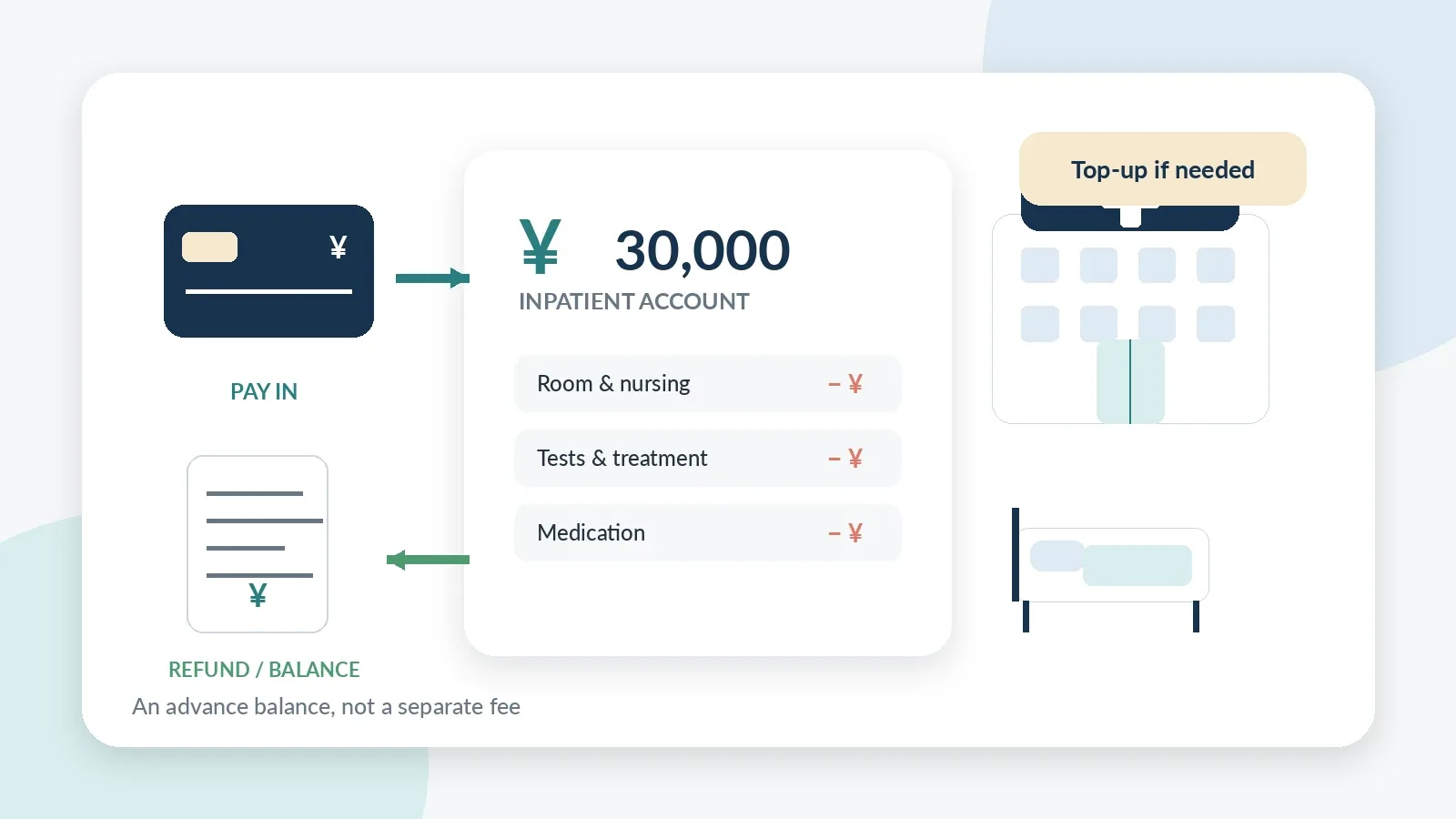
The cashier says, “The deposit is ¥30,000.”
To an English-speaking patient, the word deposit can sound like a hotel security hold: money kept untouched in case something goes wrong, then released at check-out. A Chinese hospital deposit works differently. It’s closer to a prepaid balance on your inpatient account. As the hospital provides a room, tests, medication, and treatment, charges are drawn from that balance.
This is one of the least explained parts of receiving medical care in China. Hospital websites may list doctors and room types in English, yet say almost nothing about how much cash or available credit a patient may need at admission.
The China Hospital Fees & Deposits Index tracks those figures hospital by hospital. It shows that there is no single national deposit. A straightforward admission may begin at ¥20,000 or ¥30,000. A surgical case can require ¥50,000–100,000 before the operation proceeds.
Here is what the money is for, how hospitals arrive at the number, and what happens to it when you leave.
The deposit system at a glance
| Question | Practical answer |
|---|---|
| What is the deposit? | An advance balance on the inpatient account |
| Is it added to the final bill? | No. It is applied against the final bill |
| How is the amount set? | Usually from the projected near-term cost of the case |
| What is a common starting range? | About ¥20,000–30,000 for a shorter admission |
| What about surgery? | Verified examples range from ¥30,000 to ¥100,000 |
| Can the hospital ask for more? | Yes, if the balance runs low |
| What happens at discharge? | You pay the shortfall or receive the unused balance back |
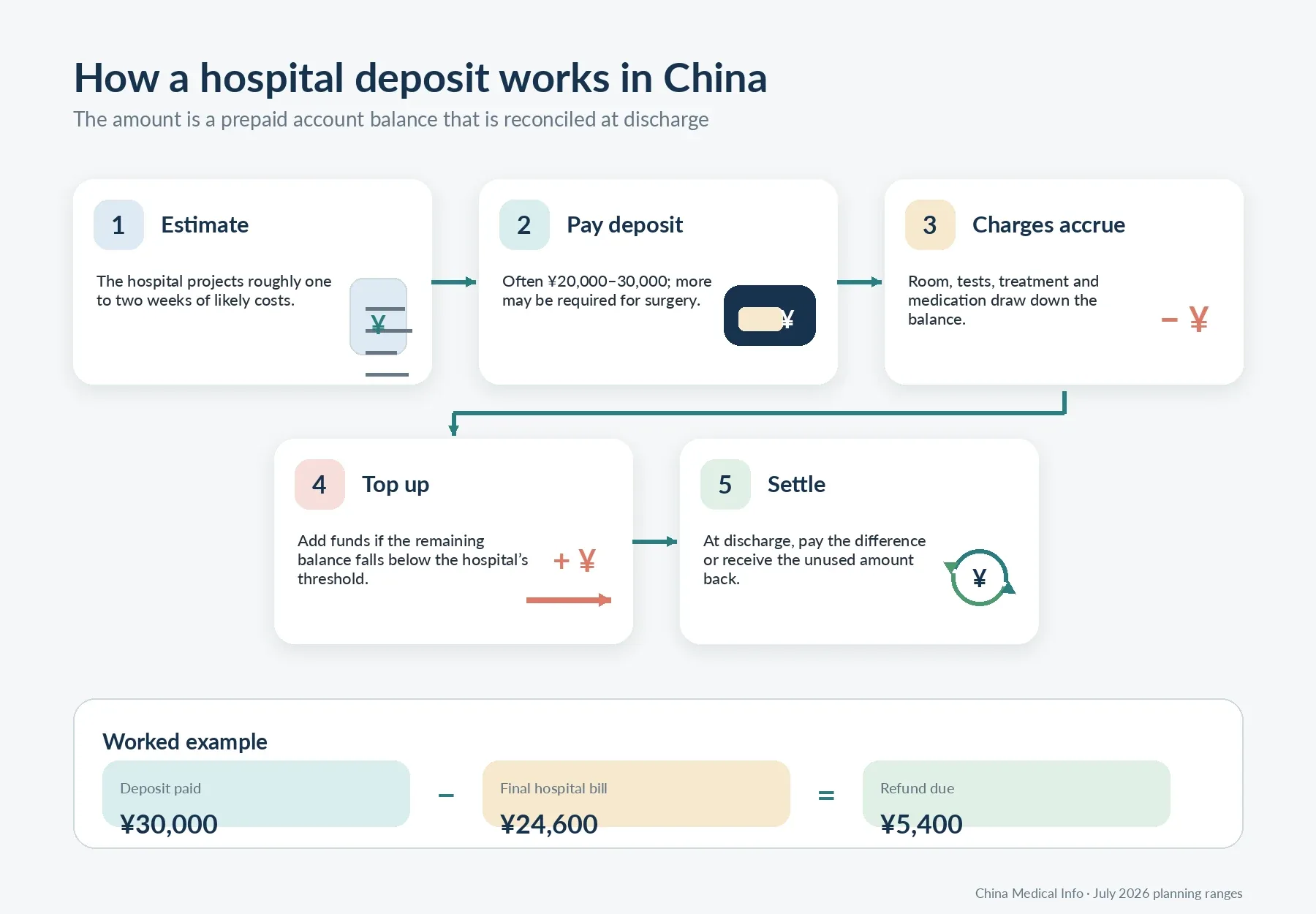
Think of the deposit as working capital for the hospital stay, not a separate entrance fee.
A hospital deposit is an advance payment, not an extra charge
The first point is the most important: the deposit isn’t normally added on top of the final hospital bill.
Suppose you pay a ¥30,000 deposit. During the stay, the hospital records ¥24,600 in room, nursing, tests, medication, and treatment charges. At settlement, ¥24,600 is taken from the prepaid balance and the remaining ¥5,400 is due back to you.
If the final charges reach ¥36,000, the deposit covers the first ¥30,000 and you pay the remaining ¥6,000.
The arithmetic is straightforward. The uncertainty lies in the bill itself. On the morning of admission, nobody knows with complete precision how many tests will be needed, which consumables will be used, or whether the stay will last three days or two weeks.
That uncertainty is the reason the deposit exists.
Why Chinese hospitals collect deposits
An inpatient episode is not a fixed retail product. A patient admitted for observation may go home in two days. The same patient may instead need a procedure, imported devices, intensive monitoring, or a longer stay. The hospital begins providing chargeable care immediately, but it cannot close the bill until discharge.
The deposit creates a working balance while treatment is under way. It also lowers the risk of a large unpaid self-pay account at the end of the stay.
This matters in international, VIP, and special-needs departments, where patients generally use self-payment or commercial insurance. Direct billing is available at some hospitals for some policies, but it depends on a network agreement and preauthorization. It should never be assumed.
There is no universal “foreigner deposit,” and hospitals don’t apply one national tariff to every patient. The amount follows the expected case.
How the hospital decides the amount: usually one to two weeks of projected costs
The most useful explanation came from hospital billing teams during the July phone checks: the initial deposit is commonly sized around the expected cost of the next one to two weeks of care.
That is an industry rule of thumb, not a published national formula. The admission office looks at what is likely to happen next. The diagnosis matters. So do the planned operation, expected length of stay, room category, devices or implants, medication, and whether an insurer has issued a guarantee of payment.
This is why a hospital may answer “it depends on the condition” rather than quote a flat number. It is also why a surgical deposit can be several times higher than the amount requested for a short medical admission.
The site’s Q&A on how much deposit Chinese hospitals require gives the current figures in a compact format.
What the verified numbers look like
The July 2026 index shows a clear pattern:
| Hospital | Initial admission deposit | Surgical deposit or higher-complexity range |
|---|---|---|
| Huadong Hospital, Shanghai | ¥20,000 | Set case by case |
| Shanghai General Hospital | ¥20,000 | Set case by case |
| First Affiliated Hospital, SYSU | ¥30,000 | Set case by case |
| Guangdong Provincial People’s Hospital | ¥30,000 | ¥50,000–80,000 |
| Beijing Chao-Yang Hospital | Set case by case | ¥30,000–40,000 |
| Beijing Tiantan Hospital | ¥20,000–30,000 for a shorter stay | ¥50,000–100,000 |
The Beijing Tiantan Hospital profile is a useful example because it separates a shorter, lower-complexity admission from surgery. The Guangdong Provincial People’s Hospital profile shows the same logic: a ¥30,000 starting deposit, rising to ¥50,000–80,000 for surgery.
These numbers are not price guarantees. They show how the system thinks. The hospital is funding the expected near-term course of care, not charging every patient the same admission fee.
You may be asked to top up the account
Paying the first deposit doesn’t necessarily carry the account all the way to discharge. If recorded charges approach the prepaid amount, the finance office may ask you to add funds.
A top-up isn’t a second deposit fee. It’s additional prepayment against a bill that is growing. In a complex case, this can happen more than once.
Before admission, ask one practical question: “At what remaining balance will you ask me to top up?” Knowing the threshold can prevent an urgent payment request late at night or shortly before a procedure.
Also confirm where top-ups can be paid. A hospital may accept an overseas Visa or Mastercard at the international cashier but not at every ward cashier. Alipay or WeChat Pay may work, but transaction limits can still matter. Bring a backup method rather than relying on one card.
What happens at discharge
At discharge, the clinical team closes its orders and the finance office produces the final account. The deposit is then reconciled against the itemized charges.
There are three common outcomes:
- The bill is higher than the deposit, so the patient pays the difference.
- The deposit is higher than the bill, so the unused balance is refunded.
- A commercial insurer is paying directly, so the hospital and insurer reconcile the approved portion and the patient settles deductibles, exclusions, or unapproved items.
Ask for the itemized bill, deposit receipt, official invoice, and final settlement statement before leaving. For an overseas insurance claim, you may also need a diagnosis certificate, discharge summary, and copies of test reports.
Refund timing and method vary. A Chinese mobile-wallet refund may arrive differently from a reversal to an overseas card. Before paying the deposit, ask where a surplus will be returned, how long the process usually takes, what identification is required, and whom to contact if the money does not appear.
Direct billing can reduce the cash burden, but it does not remove every deposit
Some international departments settle directly with major commercial insurers. Others use a pay-and-claim model: the patient pays first, collects the official invoice and medical records, and files for reimbursement later.
Even where direct billing is available, the hospital may still request a personal deposit for deductibles, exclusions, items awaiting approval, or costs beyond the insurer’s guarantee.
The Q&A on which Chinese hospitals accept international insurance direct billing explains the distinction. The safe approach is to obtain written confirmation from both the insurer and the hospital before admission.
Maternity membership packages follow a different logic
Maternity care is where the word deposit becomes especially confusing, because some Shanghai hospitals sell prenatal membership packages alongside inpatient deposits.
At the International Peace Maternity and Child Health Hospital, the “Fuqilin” program is listed at ¥38,800 or ¥65,800. The lower tier includes 15 appointment fees and access to a designated-doctor communication group. Delivery-related room choices are priced separately, and the index records a standard-ward deposit of ¥6,000 versus ¥35,000 for an integrated VIP arrangement.
Shanghai First Maternity and Infant Hospital uses a similar structure. Its “Golden Key” membership is listed at ¥35,000 and includes 13 outpatient visits plus two emergency visits. The inpatient deposit is a separate amount: approximately ¥5,000 for a standard ward and ¥35,000 for VIP care.
Those membership payments aren’t simply refundable security deposits. They purchase a package of access, appointments, communication, and other services. Cancellation and refund terms therefore depend on the membership agreement, not only on the final delivery bill.
Before joining a maternity program, ask for a written list of what is included, what is excluded, whether unused visits can be refunded, and whether delivery, the room, newborn care, anesthesia, and emergency treatment are billed separately.
What foreign patients should prepare before admission
Ask the hospital for a written estimate that separates the inpatient deposit, surgical deposit, daily room or service fee, planned procedure, medication, devices, and consumables.
Confirm the accepted payment methods and the refund route. A hospital may accept Visa or Mastercard for payment but handle a refund through a different process.
Bring the passport used for registration, the admission notice, relevant medical records, insurer contact details, and the name of the person responsible for payment. Keep digital and paper copies of every receipt.
For commercial insurance, ask whether direct billing is available, whether preauthorization has been issued, what the insurer will not cover, and whether the hospital still requires a personal deposit.
Most importantly, keep enough available funds or credit for a top-up. A quoted deposit is an opening balance, not a cap on the final hospital bill.
Frequently asked questions
Is the deposit higher simply because I am a foreigner?
Hospitals do not use one standard “foreigner deposit.” The amount is usually tied to the expected treatment, length of stay, room type, and payment or insurance arrangement.
Can I refuse to pay the deposit?
For a planned admission, the hospital may require payment or an accepted insurer guarantee before completing the admission. Emergency handling can follow different procedures, but payment rules still need to be confirmed with the hospital.
How quickly will an unused deposit be refunded?
There is no universal timeline. It depends on the hospital, payment channel, account closure, and whether an insurer is involved. Ask before paying and keep the settlement documents.
Does direct billing mean I will pay nothing upfront?
Not necessarily. The hospital may still collect money for deductibles, exclusions, non-covered items, or charges not yet authorized by the insurer.
Is a maternity membership fee the same as an inpatient deposit?
No. A membership fee buys a defined service package. The inpatient deposit is a separate advance balance applied to the hospital account.
The bottom line
China’s hospital deposit system becomes much less mysterious once the word deposit is translated into its real function: advance funding for care that has not yet been fully delivered or priced.
For many international patients, a practical planning range is ¥20,000–30,000 for a shorter, lower-complexity admission and ¥50,000–100,000 for surgery. Hospitals commonly size the opening amount around one to two weeks of expected charges, then request a top-up if care becomes more intensive or lasts longer.
At discharge, the money is applied to the final account. The patient pays a shortfall or receives the unused balance back. Maternity membership packages are the important exception: they are service contracts and need to be read under their own terms.
The practical lesson isn’t just “bring money.” Ask what the amount represents, how it was calculated, what could trigger a top-up, and exactly how any surplus will be returned.
Sources and scope: China Hospital Fees & Deposits Index, phone checks with hospital international or special-needs departments conducted July 15–21, 2026, and related China Medical Info hospital profiles and Q&A pages. This article provides general educational information only. It is not medical, insurance, or financial advice.