
Guides / Hospital costs
How Much Does It Cost to See a Doctor in China? A Verified 2026 Walkthrough
Hospital fees change by city, department, doctor, diagnosis, room type, medication, and treatment plan. Treat every figure below as a planning range, not a quotation, and reconfirm it directly with the hospital.
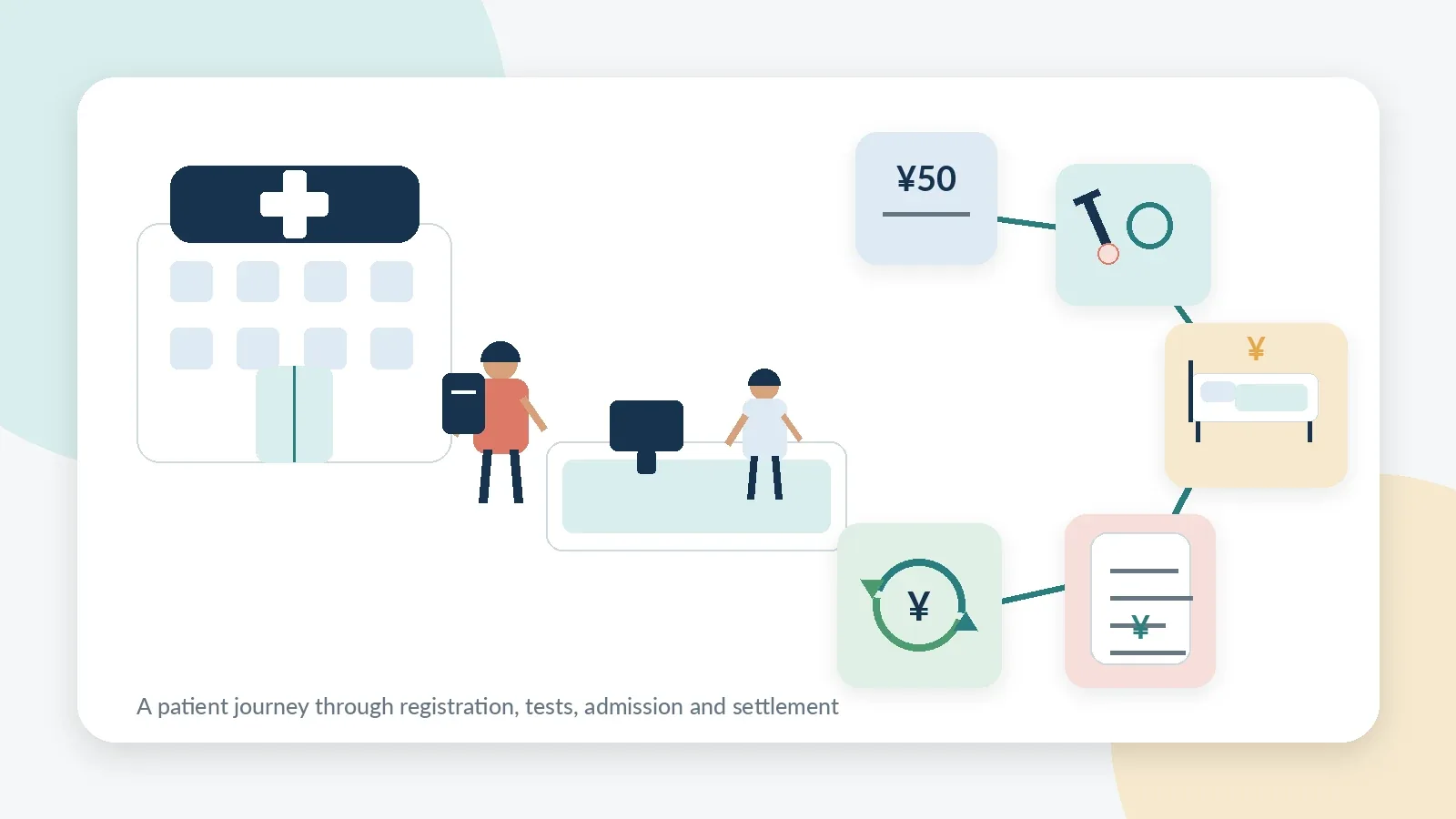
At 8:20 on a weekday morning, you walk into a large public hospital in China with your passport, a folder of medical records, and no clear idea what the day will cost. Before you have even seen a doctor, you face the first financial decision: use the regular outpatient department, book a special-needs or VIP clinic, or go through the hospital’s international department.
That choice can move the opening price from about ¥50 to ¥400–1,200. It can also change the booking process, the amount of English-language help available, the waiting environment, and how commercial insurance is handled.
There is no single consultation price. The bill develops in stages. The most useful way to understand it is to follow the same route your wallet follows: registration, the consultation, tests, admission, the hospital stay, and final settlement.
The ranges in this guide come from the China Hospital Fees & Deposits Index, which records phone-verified fees from international and special-needs departments in Beijing, Shanghai, and Guangzhou.
The cost journey at a glance
| Stage | Typical planning range | What to remember |
|---|---|---|
| Regular outpatient registration | About ¥14–100, depending on city and doctor rank | Usually includes the consultation itself |
| International or VIP registration | Commonly ¥400–1,200 | Renowned experts can cost more |
| Tests and procedures | Billed separately | Do not apply one multiplier to every test |
| Initial inpatient deposit | Often ¥20,000–30,000 | It is an advance balance, not an extra fee |
| Surgical deposit | Roughly ¥30,000–100,000 in verified examples | Set by hospital and case complexity |
| International inpatient room or package | About ¥800–5,000+ per day in the current index | Check whether nursing and clinical service are included |
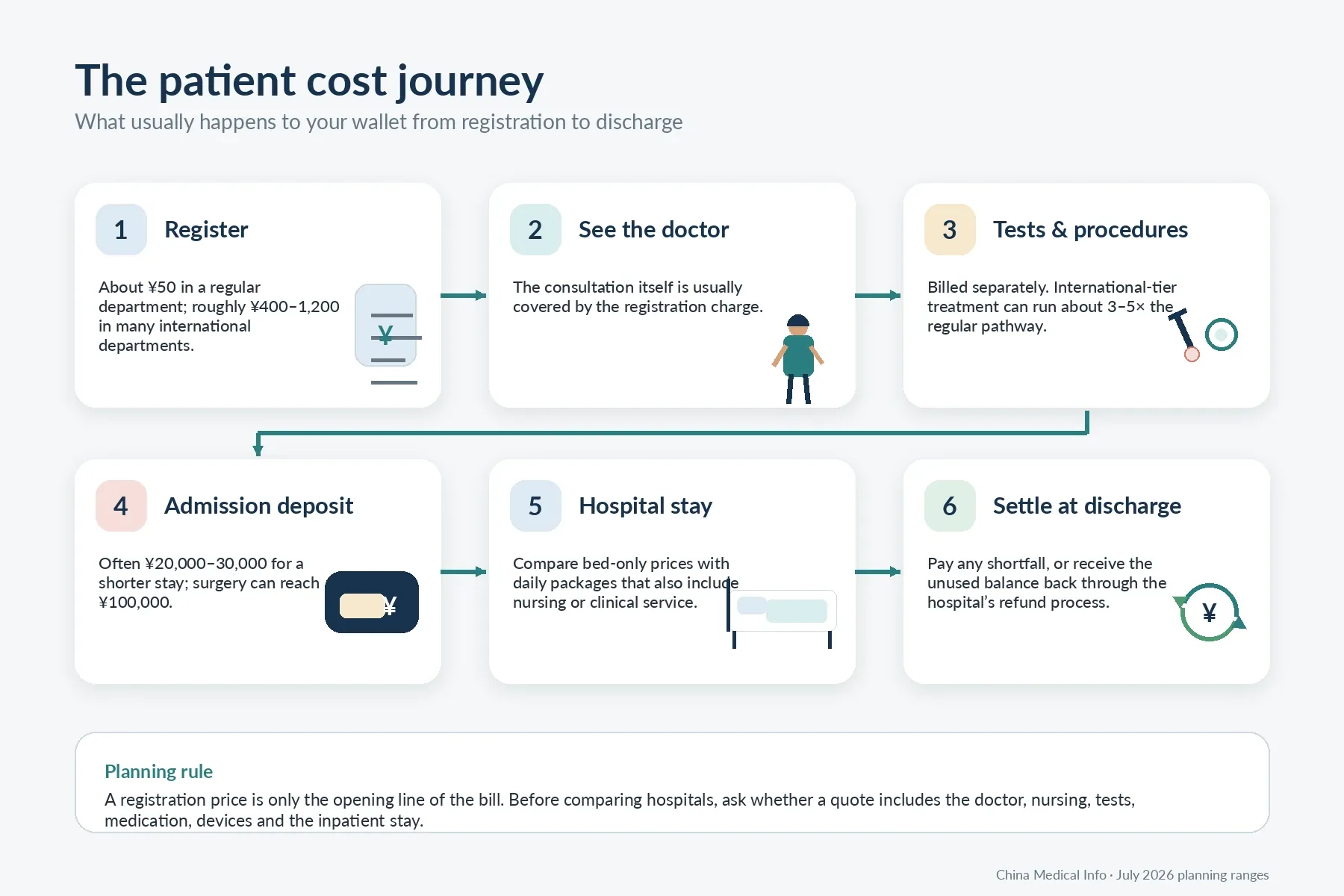
The opening fee is only the first line of the bill. Ask what is included before comparing hospitals.
Step 1: Registration — about ¥50 in a regular department, often ¥400–1,200 internationally
In a standard public outpatient department, registration is usually the cheapest part of the day. The official fee varies by city and doctor rank. Beijing’s regular outpatient medical service fees run from ¥50 to ¥100; Shanghai’s large public hospitals are generally around ¥14–25; and Guangzhou’s 2026 schedule uses ¥25, ¥39, and ¥50 tiers.
For a quick mental budget, “about ¥50” is still a fair starting point for an ordinary public-hospital appointment.
The international department is a different service tier. Across the hospitals in the index, an appointment with an associate chief physician or chief physician commonly falls around ¥400–1,200. A nationally known specialist may cost more, and a small number of elite expert clinics in Shanghai go well beyond that range.
At Fuwai Hospital, the national cardiovascular center in Beijing, a phone-verified international appointment runs ¥900–1,000, depending on the doctor tier. The Fuwai Hospital profile lists its verified fees alongside the current room rates.
This is why two patients can give completely different, yet equally honest, answers when asked what a doctor visit costs in China. One paid roughly ¥50 and queued in the regular department. Another paid ¥900 for a scheduled international appointment with more administrative support. They may have seen doctors in the same hospital, but they didn’t buy the same experience.
For a compact city-by-city answer, see the Q&A page on how much a doctor visit costs in China.
Step 2: The consultation — usually covered by the registration charge
The phrase “registration fee” can be misleading in English. At most Chinese public hospitals, that payment also covers the doctor encounter. You don’t normally pay one amount to register and then a second, identical amount simply for sitting down with the doctor.
What the higher international fee buys is the appointment tier and the service around it: a more managed booking process, a quieter clinic, help navigating the hospital, and, at many facilities, English-speaking staff or interpretation support. It doesn’t usually include blood work, imaging, medication, pathology, anesthesia, or procedures.
That distinction matters. If the doctor reviews your records, gives an opinion, and orders nothing else, your outpatient spending may stop close to the registration price. Once tests are added, the consultation often becomes the smallest line on the bill.
A sensible starting rule is to budget ¥400–1,200 to get through the door of many international departments, but never treat that number as the cost of the entire visit.
Step 3: Tests and procedures — where the bill becomes harder to predict
This is the point where tidy online price lists stop being very helpful.
International-department treatment and procedures commonly cost around three to five times the regular hospital pathway. One phone-verified example from Zhongshan Hospital compared a treatment costing roughly ¥3,000 through the regular service with about ¥15,000 through the international department. The Zhongshan Hospital profile lists its current international registration and inpatient package ranges.
The three-to-five-times pattern is useful for planning, but it isn’t a universal multiplier for every blood test, ultrasound, or CT scan. Some stand-alone tests remain close to government-guided prices. Others become more expensive because the international pathway adds anesthesia, imported consumables, premium scheduling, extra clinical service, or a bundled facility charge.
The useful question isn’t “How much is the test?” but “What does the estimate include?”
For a CT scan, confirm whether contrast and the radiology report are included. For endoscopy, ask about anesthesia, pathology, and disposable equipment. For surgery, separate the surgeon, operating room, devices or implants, medication, and inpatient stay.
A doctor may say, “You need a gastroscopy.” The question that protects your budget is, “What is the estimated all-in price in this department?”
Step 4: Admission — the hospital may ask for ¥20,000–30,000 before treatment starts
If the doctor decides you should stay in hospital, the payment logic changes immediately. The inpatient cashier may request a deposit before admission is completed.
For a relatively straightforward stay, ¥20,000–30,000 appears repeatedly in the verified index. Huadong Hospital and Shanghai General Hospital both put the admission deposit at ¥20,000. The First Affiliated Hospital of Sun Yat-sen University and Guangdong Provincial People’s Hospital quote ¥30,000.
Surgery can require much more. Beijing Chao-Yang Hospital cites ¥30,000–40,000 for surgery. Guangdong Provincial People’s Hospital quotes roughly ¥50,000–80,000. Beijing Tiantan Hospital gives one of the clearest planning ranges: approximately ¥20,000–30,000 for a shorter, lower-complexity admission and ¥50,000–100,000 for surgery. The Beijing Tiantan Hospital profile shows those deposit ranges alongside its room fees.
The deposit is not a surcharge. It is money placed on your inpatient account so the hospital can deduct charges as care is delivered. If the balance runs low, you may be asked to add funds. If the final bill is lower than the amount paid in, the unused balance is returned during the settlement process.
For many foreign patients, this is the biggest surprise. The treatment may be affordable in total, but the hospital still expects substantial liquidity at the beginning.
Step 5: The hospital stay — compare what is included, not just the daily price
International inpatient prices are easy to misread because hospitals don’t all quote the same thing.
Some Beijing hospitals publish a room or bed fee. Beijing Tiantan, for example, lists approximately ¥800–1,200 for a standard room tier and ¥1,500–2,000 for a higher tier. Other hospitals sell a daily package that already includes nursing or clinical service.
In Shanghai, Zhongshan Hospital lists an all-inclusive base of about ¥3,800 per day, with medication billed separately. Renji Hospital lists a ¥5,000 private-room day made up of the bed, clinical service, and nursing. Xinhua Hospital’s private-room total is about ¥2,800 using the same three-part structure.
Those numbers are not directly comparable. A ¥1,200 bed fee may become more expensive once nursing and clinical service (the 诊疗费 physician-care line) are added. A ¥5,000 package may already contain several items another hospital bills separately.
Before admission, ask the finance office to split the estimate into five lines: room, nursing, clinical service, tests and treatment, and medication or consumables. That one request makes hospital quotes much easier to compare.
Step 6: Discharge — the deposit is reconciled against the final bill
At discharge, the hospital closes the account. Every recorded charge is added up, the deposit is applied, and the difference is settled.
Suppose you paid a ¥30,000 deposit and the final bill is ¥24,600. The hospital applies ¥24,600 to the account and returns ¥5,400. If the final bill is ¥36,000, the deposit covers the first ¥30,000 and you pay the remaining ¥6,000.
The arithmetic is simple. The refund process may not be. A refund to a Chinese mobile wallet can work differently from a reversal to an overseas Visa or Mastercard. Direct billing through a commercial insurer may involve a separate reconciliation and preauthorization process.
Keep the deposit receipt, itemized bill, official invoice, and final settlement slip. Those documents matter if a refund is delayed or if you need to claim reimbursement later.
What should you actually budget?
For a brief regular outpatient visit with no tests or medication, start with roughly ¥50–100, depending on the city and doctor rank.
For an international outpatient appointment, a realistic opening budget is ¥400–1,200. A renowned expert may cost more. Once imaging, endoscopy, pathology, or a procedure is added, the visit can move into several thousand yuan.
For admission, be ready for an initial deposit of roughly ¥20,000–30,000 for a shorter, lower-complexity stay. A surgical deposit of ¥30,000–100,000 is possible, depending on the hospital and procedure. Daily international inpatient charges in the current index range from under ¥1,000 for a basic bed component to around ¥5,000 for a bundled private-room service, with higher-end options beyond that.
That is the real answer to “How much does it cost to see a doctor in China?” The first fee may be only ¥50. The meaningful cost depends on which door you choose, what the doctor orders, and whether your visit ends at the outpatient cashier or continues upstairs to a ward.
Frequently asked questions
Can foreigners use the regular public outpatient department?
Yes. Foreign patients can generally register with a passport and use the regular public pathway. The trade-offs are longer queues, less administrative help, and no guarantee of English support.
Is the doctor’s consultation charged separately from registration?
Usually not in a public hospital. The registration or medical service fee normally covers the consultation. Tests, medication, procedures, and follow-up visits are separate.
Does every international-department test cost three to five times more?
No. The three-to-five-times pattern is more useful for treatment, procedures, and the overall international service tier. Individual tests may remain closer to regulated prices or may rise because of added services and consumables.
Is the inpatient deposit an extra hospital fee?
No. It is an advance balance applied to the final account. You pay a shortfall or receive the unused amount back at settlement.
Will an overseas credit card work?
Many major international departments accept Visa or Mastercard, but regular-department cashiers are less consistent. Confirm the payment and refund method before admission, and keep a backup option.
Sources and scope: China Hospital Fees & Deposits Index, phone checks with hospital international or special-needs departments conducted July 15–21, 2026, and related China Medical Info hospital profiles. This article provides general educational information only. It is not medical, insurance, or financial advice.