Bringing Prescription Medication to China: A Practical Verification Checklist
Travelers often ask whether they can bring a prescribed medicine into China. There is no reliable one-line answer for every product. The result depends on the active ingredient, its legal classification in China, the amount, how it is documented, and any country through which you transit.
Chinese customs law allows reasonable quantities of articles for personal use, subject to restrictions and declaration requirements. Narcotic drugs, psychotropic substances, and other controlled products receive special treatment. A valid prescription in your home country does not by itself prove that an ingredient may be imported into China.
Use this guide as a verification checklist, not as legal or medical clearance.
Start with the active ingredient, not only the brand name
Brand names differ between countries and can contain different ingredients. Write down:
- the generic name of each active ingredient;
- the strength and dosage form;
- the prescribed daily dose;
- the total quantity you plan to carry;
- and the condition for which it was prescribed.
Ask the prescribing clinician or pharmacist to check this list. If a product contains more than one active ingredient, record all of them.
Then seek current written guidance from a Chinese embassy or consulate and, where necessary, China Customs. For controlled medicines, also check whether an import permit or other prior authorization is required. Do not rely on a forum post about a similar brand.
Check every country on the itinerary
Transit rules matter even if you do not intend to leave the airport. A medicine permitted at your destination may be restricted in a connection country. Check the customs, controlled-drug, and airport-security rules for each jurisdiction on your route.
If an airline will carry syringes, injectable medicine, refrigerated products, or liquid medication, ask the airline what documentation and packaging it requires. Airline approval does not replace customs approval, and customs approval does not guarantee that an item can pass aviation-security screening in every country.
Carry a quantity that clearly matches personal use
Chinese customs rules use the concept of a reasonable quantity for personal use. They do not create a single universal “30-day” or “90-day” allowance that applies to every medicine and traveler.
Carry only what is reasonably connected to the trip, plus any contingency amount permitted by the relevant authorities. A large supply, repeated packages, or products for another person can raise different questions. If you need an extended supply, ask for written advice before travel rather than guessing.
Declare items accurately when a declaration is required. Never divide medicine between travelers to disguise the total amount or remove identifying packaging to avoid inspection.
Keep the original packaging and supporting documents together
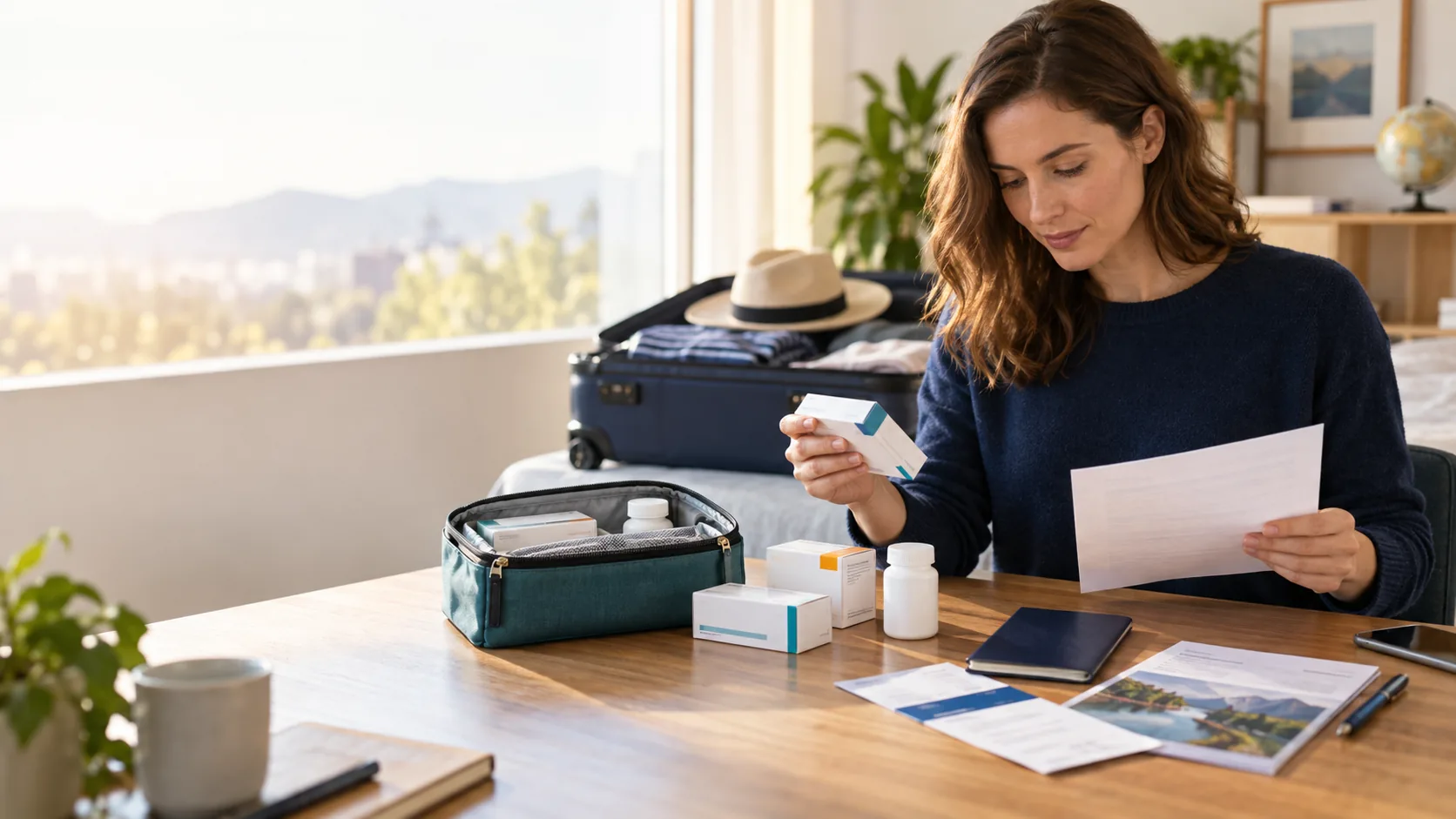
Unless an authority instructs otherwise, keep medicine in the pharmacy-labeled or manufacturer packaging. Carry documents that identify both the patient and the medicine, such as:
- a copy of the prescription;
- a clinician's letter on professional letterhead;
- the generic and brand names;
- the strength, dose, and total quantity;
- the medical reason for use;
- and the prescriber's contact details.
The name on the documents should match the passport. An English document may be useful, and a Chinese translation can help explain the contents, but translation does not legalize a prohibited or restricted substance. Keep the original document with any translation.
Avoid carrying loose tablets in an unmarked organizer as the only evidence of what they are. You can still use an organizer during the trip after you have completed entry formalities, provided you retain the identifying packaging and instructions.
Keep essential medicine accessible during travel
Many travelers keep essential medication and documents in hand luggage to reduce the risk of delay or lost checked baggage. Follow airline rules for liquids, needles, cooling packs, batteries, and medical devices.
For temperature-sensitive medicine, ask the manufacturer or pharmacist for the approved storage range and travel procedure. A hotel refrigerator may be too cold or may freeze items. Do not improvise storage conditions for a medicine whose stability matters.
Do not stop, substitute, split, or change the dose of prescribed medicine solely to simplify travel without advice from the clinician responsible for your treatment.
Plan for refills and replacements before departure
Do not assume a foreign prescription can be filled in China or that the same formulation and brand will be available. If you may need more medicine during the trip:
- identify a hospital or clinic that can assess the condition;
- ask whether the active ingredient is available locally;
- bring a concise medical summary and previous prescription;
- allow time for a local consultation and any required tests; and
- confirm how you would obtain records for your clinician at home.
Online marketplaces are not a safe substitute for a licensed medical and pharmacy pathway. Product authenticity, storage, dosage, and legal status all matter.
A pre-travel checklist
Before flying, confirm:
- each active ingredient and its classification in China;
- requirements for controlled medicines;
- rules in every transit country;
- airline and security requirements for liquids, needles, or cooling equipment;
- the permitted quantity and any declaration procedure;
- original labeled packaging;
- prescription and clinician letter matching the passport name;
- storage requirements throughout the journey;
- and a plan for loss, delay, or an unexpectedly longer stay.
Keep digital copies of the documents in secure storage, but carry the originals or official copies required by the authorities.
Frequently asked questions
Is a prescription enough to bring medicine into China?
Not always. A prescription helps establish legitimate personal use, but the ingredient may still be controlled or restricted. Check its legal status and any permit requirement before travel.
Is there a universal 30-day or 90-day limit?
No single quantity rule can safely be applied to every medicine. Official guidance refers to reasonable quantities for personal use, while controlled products can have separate requirements. Obtain case-specific guidance.
Should I translate the prescription into Chinese?
A clear translation can help explain the medicine, but it is not a substitute for the original prescription or official authorization. Keep the original and translation together.
Can I buy a replacement in China?
Possibly, but the medicine, formulation, brand, or dose may differ, and a local prescription may be required. Arrange a consultation through a legitimate hospital or clinic rather than assuming a direct replacement is available.
What if my medicine is controlled?
Contact a Chinese embassy or consulate and the relevant customs authority before booking. Ask what prior permission, documents, quantity limits, and declaration steps apply to the exact active ingredient.
Sources and scope
Public sources consulted on September 18, 2026:
- General Administration of Customs of China: Customs Law of the People's Republic of China
- General Administration of Customs of China: Articles prohibited from import and export
- Chinese Embassy in Germany: FAQ on carrying medicines for personal use
- UK Government: Health advice for China
- Government of Canada: Travelling with medication
This article provides general travel-planning information, not medical or legal advice. Rules and classifications can change. Obtain current guidance for each ingredient from the appropriate Chinese authority and from every transit country before travel.